Monday, 23 April 2012

Yinka Shonibare and his "Crisis" Entry in "The Crisis Commission"

His interest lies not only in differences associated in disability culture but in ethnic cultural difference, often merging his Nigerian background and British upbringing into his artwork; as well as other cultural influences such as Indonesian fabrics. Shonibare, when in interview with Kate Kellaway, Observer, explained his artwork, “Crisis” (The Crisis Commission Exhibition: London, March 14th – April 22nd, 2012) with the intention of it to rouse “empathy in those who have for those who do not..There is always a possibility your wealthy world could come crashing down anytime.” Unaware to the extent of how his disability (transverse myelitis) and/or the concept of disability has affected his work, his worries are consistent with that of homelessness. The hardships associated with finding work are multiplied when one has a disability and often high medical bills lead to homelessness. His fascination with culture and identity can be linked quite close to that of disability through homelessness, as this resolution is often avoidable through the support of your family, your direct link to personal culture, influence and identity. 

Yinka Shonibare "Crisis" 

Thursday, 19 April 2012

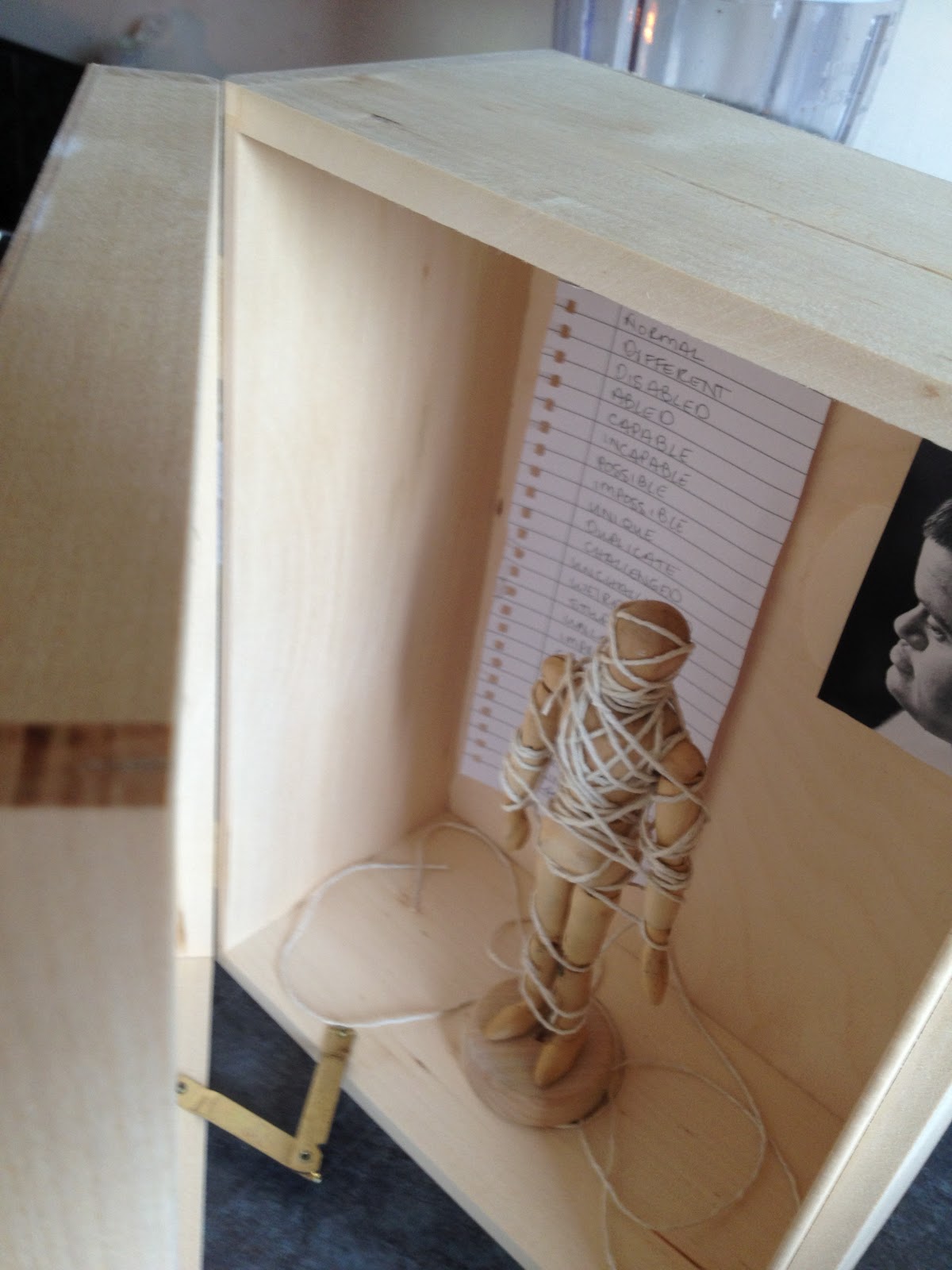
"Man in the Box"


This sculpture, "Man in the Box", quickly materialized after remembrance of a past concept involving various materials. Here, a simple, wooden box houses a mannequin which is constrained by string. Behind the mannequin is a photograph of a young man with Downs Syndrome. On the right hand side is a list of descriptive words. There are numerous amounts of synonyms, which develops endless possibilities to the description of people, places and things, which can be either positive or negative words. The list hanging in the box are both positive and negative descriptive words, which the audience has most likely used at various times in their lives; words which they've most likely used to describe varied people or have heard describing them. 

Monday, 16 April 2012

Avi Gupta's "There is Here" Photographic Exhibition @ SCVA

Photographs of what might have been in Norwich exhibition

Article by Simon Parkin 

They’re devoid of people yet filled with human presence, leaving us with the sensation that something has just happened or is about to happen. SIMON PARKIN looks at an exhibition of the photographs of Avi Gupta.


Part of "There is Here" Series, Avi Gupta, Sainsbury's Centre for the Visual Arts (SCVA).


Avi Gupta captures found situations, untouched by the artist yet framed by him to highlight subtle details and unexpected juxtapositions.
There Is Here is his first UK exhibition, specially commissioned by the Sainsbury’s Centre and launching its new contemporary art gallery Next Modern.
Avi Gupta’s parents emigrated from India to America and his work is influenced by the experience of growing up as part of the Bengali community in Washington DC.
The exhibition includes a series of over 30 photographs taken inside Bengali homes in Kolkata, India and the Washington area (four of which are pictured here).
With a variety of print sizes ranging from intimate to larger than life, the images depict everyday household scenes as found by the artist: slices of pumpkin resting on a kitchen table, an empty prayer room after a puja, unworn jeans lying on a bed.
Even though human interaction is evident in the scenes, no people are pictured in the exhibit, encouraging the viewer to contemplate the inhabitant’s presence through their possessions.
The exhibition also features a video piece, Sitting Room, and a sub-series of photos titled Offerings, which portray the various foods the artist was offered during his home visits.
His photographs are both personal and linked to universal themes, with explorations of globalisation, value systems and cultural hybridity shown through the detail of domestic life.
“I find it critical to produce pictures that provoke contemplation,” says the photographer. “By approaching photography with a subtractive mentality, I repeatedly question what should not be included in any given scene. The resulting images are minimal and quiet, deliberately devoid of people, hinting at their presence through the residue of their absence.
“The mood is melancholy and nostalgic, yet aesthetically welcoming the viewer to explore the ideas of belonging and identity within the parameters of home.”
Emily Crane, Sainsbury Centre curator, said: “Avi Gupta is an incredibly talented photographer, constantly searching for alternative modes of photographic representation and how to move away from the ubiquitous photographic styles that fill our everyday lives. Yet the images for the exhibition are about the everyday, the beauty of the found domestic environment and the poetry of the signifiers of human adaptation across continents.
“This sensitive and thoughtful work is being revealed for the first time in this exhibition of unique and powerful photography of the home.”

Wolfgang Tillmans and Avi Gupta Method of Hanging

Mr. Simon Granger, tutor, suggested exploration into Wolfgang Tillman's methods of hanging to coincide with my ideas for a minimalist approach to hanging. After contacting Galerie Buchholz, Berlin, Michael Kerkmann, kindly sent me an illustrated instructional sheet of how Tillmans hangs his unframed c-prints. Before I print my final pieces for hanging in the Degree Show, I will do a 'Tillman Test' to see how this method suits my work.


Part of the Illustrated Instructions of Wolfgang Tillman's Unframed Hanging Methods.


After attending the "There is Here: Photographs by Avi Gupta" exhibition at the Sainsbury's Centre for the Visual Arts (SCVA), I quite enjoyed the method of exhibiting. I am not entirely sure how its achieved so I contacted SCVA's curator of the show, Emily Crane and am awaiting her reply. The image is thick and protrudes slightly from the wall. Although producing the exact method may be difficult and/or expensive, I have considered a cost-effective similar method. If a regular c-print is pasted to a thick art board and then styrofoam (smaller in dimension than the board) pasted at the back, will allow the photograph to remain stiff while the styrofoam will allow the image to protrude from the wall. This way, framing still doesn't affect the work being contained but the work is emphasised.

UPDATE: Emily Crane's reply back, regarding Avi Gupta's installation.


Thanks for your positive feedback- I'm glad you enjoyed the show!  We used a jet printer with filters onto gloss paper, (done in washington), and then in the uk they were mounted onto diabond, with subframes behind to mount them on the wall, and then finally a matt seal was provided to get the matt finished and to help protect the images with a uv filter. We used metro imaging for everything but the printing, a great professional company in London, and further details of materials are on their website. 

Best wishes and good luck with your final show,

Emily 

Sketches, Visuals, Tests

Concept: Merging Sean as an adult and youngster.


Concept: Painting Sean painting. The method of expression, used to capture expression. 


Concept: Drawing style to represent the energy presented in Sean's spirit. 


Concept: Exhibiting Sean more literally and physically. Expressing the point of view that his brain is physically no different to any other, even though his facial features are associated with imperfection. 


Concept: Bringing physically associated "perfect" forms (the egg, and crisp white threaded cloth) used to represent the duality of perfection and imperfection. 


Concept:  Bringing physically associated "perfect" forms (the egg, and crisp white threaded cloth) used to represent the duality of perfection and imperfection. 
  (Detail of message included in sculpture/installation concept: "Although different, he's the same as you.") 


Concept: Incorporating Sean's image with that of widely-accepted beautiful and perfect objects and forms. Using lack of gravity to represent the subtle, yet blatant attitudes/ideas/relationships people have with persons with learning challenges.  


Concept: Taking the perfect form, the egg, and making it imperfect by adding or retracting elements. Also, evolving the perfection into a different form that is neither perfect nor imperfect.


Concept: Christo inspired concept of "wrapping" objects and presenting a retrospective to an object not typically reflected on.  


Concept: Sean looking into a mirror, reflecting on himself. The reflection in the mirror looking at the audience, involving them in the personal and intimate interaction. Merging the self and societal image into one. 


Test: Two Eggs used to produce the sculptural reiterations to the previously sketched concepts. 


Test: Egg wrapped, made unidentifiable, transformed from a "perfect" form into a "different" form.  


Test: Egg wrapped, made identifiable by using clear plastic, yet transformed from a "perfect" form into a "different" form.


Test: Egg wrapped, made identifiable by using string with revealing negative space, yet transformed from a "perfect" form into a "different" form.


 Selected View. 


Concept: Another Selected View. Allows both forms to be in the same image, allowing differentiation and reflection on 'compare and contrast' terms.


Concept: Another Selected View. Allows both forms to be in the same image, allowing differentiation and reflection on 'compare and contrast' terms.


Concept: Using Bust of Sean placed infront of a mirror, reflecting on himself. Audience, walks behind bust, looking into mirror, inorder to see the face. Their reaction to the face of a Downs Syndrome person will be physically reflected in the mirror from which they are gazing. This tactic can be used to allow the audience member to reflect on their reaction to Sean, the reaction he has to himself and the relationship between the two. 


Concept: "Portrait of a Man". Black and White variation. Being void of colour, detracts any distraction from Sean. Photography makes Sean easily identifiable, on several planes. Although Sean is not literally in front of the audience member, the photograph is as literal a translation of the real person, that can be viewed by multiple audiences. Exhibiting a selection of photographs that depict various times in Sean's life presents him as a person, in equal proportions to any other who has a recorded history through photography. Photography is a widely used method of documentation of a person's life. These photographs are the representation of a person, of Sean. The audience member is not directed into a personal ideal but left to reflect and retain what they so wish. Direction is taken from the artist's hands and left to the audience. 


Concept: Another variation, allowing various values and hues in the relationship of images. This can allow certain photos to be made focal points or allow the flow of eye to be manipulated differently. 


Concept: Bringing Sean's artwork into the display allows his work to represented as a personal representation of him. 


Concept: Here, photography and placement is used to allow earlier concepts of self and societal reflection and image. Here, Sean appears to be looking at his own image, reflecting on himself, as well as looking at the audience, engaging them into the narrative of this intimate and personal relationship. 

Monday, 9 April 2012

Artist vs. Curator

Learning Outcome 12, explains to the Art Student that they must communicate effectively to a range of specialist and non-specialist audiences using means appropriate to their practice. What they are looking for, is empathy towards the audience. Therefore, the artist must act as curator as well in the exhibition of their work. 


Kwanyi Pan (Curator at the Mission Gallery, Wales, UK) says, “A curator is not a creator but a facilitator for both the audience and the artists and a messenger who delivers ideas from contemporary society. A good curator needs to understand the audience and to fully communicate with the artists to let their work speak out to the public.”


Since each artist must act as both curator and artist, both sides must be developed together. The work must be created with the exhibition in mind. In this case, the exhibition is must be considered either before the piece is completed or during its completion. In regards to my photographs, which are in essence "complete", their photographic edits, scale (in terms of printing and relation to the scale of exhibiting wall) and arrangement must be carefully considered so that the audience is told a proper tale. The work is being created or transformed for installation. Rather than each photograph being exhibited as sole works that are collectively presented, I must engage the audience by presenting a collective story through individual pieces. The story is of Sean and is a portrait of his life and/or the various views that describe him and his personality.  


Since, Hannah Wallis and Holly Stubbings are known NUCA student curators, I will get their opinion on my exhibition set up ideas. (Perhaps by using the Art Exchange, Holly Stubbings initiated project.) 


A work of art should, presumably, challenge or disrupt the viewer's expectations about a given image, object, or system of meanings and that the viewer, in turn, should require this disruption to overcome his or her reliance on habitual forms of perception.


In, 'Conversation Piece: Community and Communication in Modern Art' (2004) by Grant Kester, there is an engagement in the emergence and consolidation of a general discourse of avant-garde art during the twentieth century. In it, there is specific attention to Rachel Whiteread's House.

The Rachel Whiteread's project, House (1993) was a cast of an interior of a Edwardian terrace house in one of Lodon's poorest boroughs, Tower Hamlets. "House, like a photograph, is linked to an absent original - in this case the actual house whose destruction brought it into existence…The work serves to reveal the inability of conventional language to grasp the infinite complexity of the world and the naive, and possible reactionary constraints of a 'confectionary' consensus about the world. Here, consensus, or shared understanding is associated with something inviting but insubstantial or even unhealthy while the reputing of consensus takes on an explicitly therapeutic value."


Rachel Whiteread, House (1993)


Rachel Whiteread, House (1993)


Information can be found here: